Rugby Positions Explained: The Complete Guide to All 15 Roles on the Field
Rugby is one of the most popular sports in the UK, attracting passionate fans across England, Scotland, Wales, and Ireland. Understanding rugby positions is essential for players and spectators alike. Each position has specific responsibilities that contribute to the team’s overall performance. Knowing these roles enhances the experience of watching matches on BBC Rugby or following tournaments like the Rugby World Cup 2025.
Rugby positions are divided into forwards and backs, with each group bringing unique skills to the field. Forwards focus on physical strength, ball retention, and scrums, while backs use agility, speed, and tactical awareness to create scoring opportunities. Whether you are watching a Six Nations clash, a Women’s Rugby World Cup fixture, or a local Bath Rugby game, understanding rugby positions provides deeper insight into the game’s strategy and excitement.
Understanding Rugby Positions: Forwards vs Backs
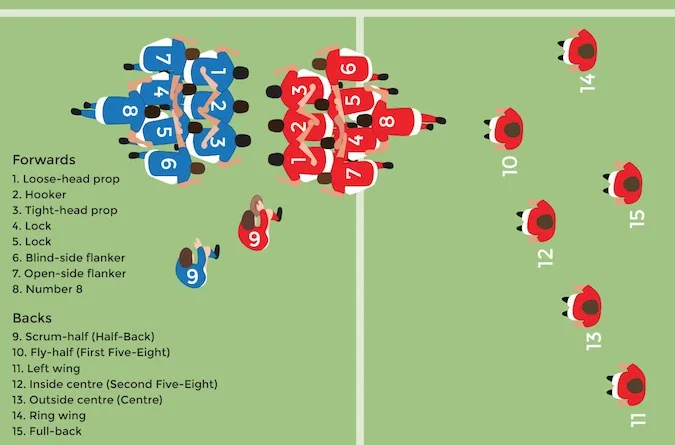
Rugby positions are generally split into forwards and backs, each fulfilling a distinct function during play. Forwards, numbered 1 to 8, are responsible for maintaining possession and winning physical battles, including scrums and lineouts. These positions require strength, stamina, and coordination, making them the backbone of any rugby team. In contrast, backs, numbered 9 to 15, excel in speed, agility, and tactical decision-making, often dictating the flow of the game and finishing attacking moves.
The distinction between forwards and backs in rugby positions significantly affects team strategy. Forwards provide the platform for backs to execute attacking plays, while backs use space and movement to exploit weaknesses in opposition defence. Observing teams such as England Rugby, Wales Rugby, and Ulster Rugby highlights how different players in rugby positions contribute to scoring and defensive systems. Watching rugby today, whether in the Six Nations or BBC Sport Rugby broadcasts, becomes much more engaging with this knowledge.
Forwards: The Engine Room of Rugby
Forwards in rugby positions form the team’s power base. The front row, including props and the hooker, is central to scrums and lineouts, providing strength and stability. Props offer raw power while the hooker throws accurately in lineouts and coordinates the scrum. Forwards are responsible for securing possession, supporting teammates in rucks and mauls, and laying the foundation for attacking plays.
The second row, or locks, are typically the tallest players on the field. They specialise in lifting teammates during lineouts, pushing in scrums, and adding momentum to driving mauls. The back row, consisting of flankers and the number eight, combines mobility with physicality, tackling opponents and linking forwards with backs. Teams such as Bath Rugby and Scotland Rugby demonstrate how dominant forwards in rugby positions can control matches and influence rugby scores.
Backs: The Playmakers and Finishers

Backs in rugby positions are the creative force behind most attacking moves. Half-backs, including scrum-half and fly-half, direct play, distribute the ball, and make key tactical decisions. These positions demand excellent vision, quick reflexes, and precise passing. Scrum-halves act as the link between forwards and backs, while fly-halves often decide the direction and tempo of attacks.
Centres provide both defensive strength and offensive flair, breaking through opposition lines and creating space for wings. Wings are fast and agile, often finishing tries and exploiting open field opportunities. The full-back covers the backfield, fields kicks, and launches counter-attacks, requiring tactical awareness and safe handling skills. Watching BBC Rugby or following rugby fixtures demonstrates how each back position in rugby positions contributes to team strategy and scoring opportunities.
Women’s Rugby Positions and Game Dynamics
Women’s rugby positions follow the same structure as men’s rugby, but with a stronger emphasis on speed, agility, and tactical intelligence. Understanding these positions is essential for following the Women’s Rugby World Cup and domestic competitions in the UK. Women’s rugby continues to grow rapidly, showcasing the importance of skillful execution in every position.
Each position in women’s rugby carries distinct responsibilities. Forwards focus on ball retention and scrummaging, while backs execute attacks and create tries. Players in England Rugby Women and Wales Rugby Women exemplify how mastering rugby positions can change the outcome of matches. Awareness of these roles allows fans to appreciate the growing popularity and competitiveness of women’s rugby today.
How Positions Influence Match Strategy and Scores
Rugby positions play a critical role in shaping team tactics and match outcomes. Forwards secure the ball, dominate scrums, and provide a platform for backs to execute scoring opportunities. Backs use speed and skill to exploit gaps, finishing plays and creating tries. Teams that balance forwards and backs effectively often dominate rugby scores and overall performance.
Coaches design strategies around rugby positions to maximise strengths and cover weaknesses. Observing high-profile tournaments such as the Rugby World Cup 2025, Six Nations, or local Bath Rugby and Ulster Rugby fixtures reveals how players in rugby positions contribute to both attack and defence. Fans watching BBC Sport Rugby can identify the influence of each position on match dynamics, adding depth to the viewing experience.
Common Myths and Misconceptions About Rugby Positions
There are several misconceptions surrounding rugby positions. Some believe forwards are only about size and strength, while backs are solely agile and fast. In reality, players in all rugby positions require a combination of skill, strategy, and adaptability to excel. Understanding these nuances enriches appreciation of the game.
Another common myth is that players cannot switch positions during their career. Many players successfully transition between forwards and backs or within their group, showcasing versatility. Recognising the fluidity of rugby positions allows fans and aspiring players to see the game as more dynamic and strategically complex than it appears.
Conclusion
Rugby positions are central to every team’s success, shaping strategy, scoring, and gameplay. From powerful forwards to creative backs, understanding rugby positions enhances both playing and spectating experiences. Observing teams like England Rugby, Scotland Rugby, and Bath Rugby, and following events such as the Women’s Rugby World Cup and Rugby World Cup 2025, becomes more rewarding when the roles of each player are clear.
You may also read: Basketball Accessories and Essentials