
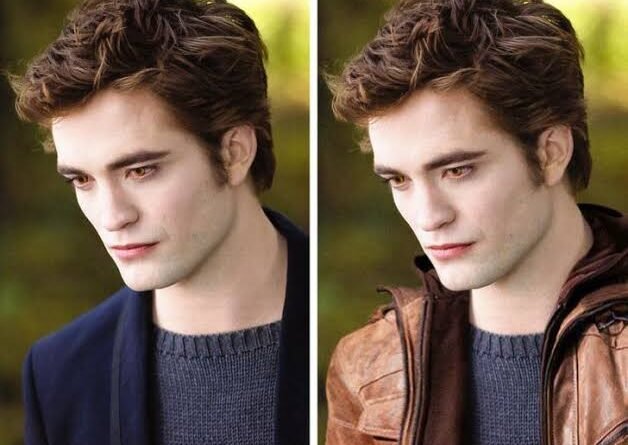
Edward Cullen Through the Books: How the Character Evolved Across the Twilight Saga
Not every character changes across the course of a story. Some exist to serve the plot, to react, to provide context for the protagonist’s journey. Edward Cullen is not that kind of character. Across five novels — four in the main saga plus Midnight Sun — he undergoes a genuine arc that is easy to miss if you read the books as a straightforward love story rather than a character study.
This article traces Edward Cullen’s evolution from the first pages of Twilight to the final chapters of Breaking Dawn, examining how his choices, his self-understanding, and his relationship with the world around him shift across more than a thousand pages of story.
Edward Cullen in Twilight — Control on the Verge of Breaking
When readers first encounter Edward Cullen in Twilight, he is a study in extreme tension. He is sitting in a high school cafeteria, surrounded by people whose thoughts he can hear and whose blood he can smell, performing the performance of normalcy that the Cullen family has refined over decades. He is very good at it. He has had a long time to practice.
Then Bella Swan walks in, and everything he has built starts to crack.
The Edward of the first book is at war with himself in a way that is palpable on the page. His attraction to Bella is not simply romantic — it is physical in a way that is genuinely dangerous. Her blood calls to him more powerfully than any human’s he has ever encountered in over a century of vampire existence. His first instinct, one he barely manages to suppress, is predatory. He comes close to killing an entire classroom of students just to get to her. He requests a class transfer. He considers leaving Forks permanently.
What Twilight shows us in this early Edward is a vampire at the absolute limit of his self-control — someone who has worked for decades to build a careful, disciplined existence, and who meets in a single afternoon the one thing capable of dismantling it. His choice to stay, to engage, to eventually protect rather than destroy, is the foundational decision of the saga. Everything that follows is built on that moment.
Edward in Twilight is also deeply secretive. He guards information about himself with the precision of someone who has long understood that vulnerability has a cost. He answers Bella’s questions in half-measures. He issues warnings while simultaneously making it harder for her to stay away. He is simultaneously pulled toward her and afraid of what that pull means — and he handles this contradiction by being oblique, watchful, and in control of every interaction in a way that will begin to loosen as the series progresses.
Edward Cullen in Midnight Sun — The Same Story, Completely Different Character
Midnight Sun, published in 2020, retells the events of Twilight from Edward’s perspective, and it fundamentally changes how the first book reads.
What appeared from Bella’s point of view as cool, mysterious, and slightly intimidating is revealed from Edward’s perspective as barely contained panic. The cafeteria scene — where Edward sits stone-faced and avoids Bella’s gaze — is actually a moment of desperate internal crisis. He is calculating exits. He is monitoring the other students. He is talking himself back from the edge. The control that reads as aloofness from the outside is, from the inside, almost total psychological effort.
Midnight Sun also deepens the character by revealing how Edward experiences his telepathy on a daily basis. Hearing everyone’s thoughts is not a superpower in any enjoyable sense. It is noise — constant, unasked-for, impossible to turn off. He has developed strategies for managing it, ways of tuning certain voices down while remaining alert to others, but it is exhausting. One of the reasons Bella’s mental silence is so startling is simply the relief of it. She is quiet in a way that nothing else in his world ever is.
The Edward of Midnight Sun is also notably funnier than Bella’s version of him. He has a dry, private sense of humor that surfaces in his internal commentary on the people around him. He is fond of his family in ways that Bella’s narration can only partially capture, because she is not privy to the warmth of their telepathic-adjacent closeness. Midnight Sun makes him more human, not less — which is a significant achievement for a novel about a vampire.
Edward Cullen in New Moon — The Cost of a Decision
New Moon is the book where Edward is mostly absent, which makes it the book that most clearly defines what his presence means to the story.
When Edward leaves Bella at the beginning of New Moon, he makes the decision that the rest of the saga will spend hundreds of pages processing. His reasoning is examined in detail elsewhere — the short version is that he believes her safety requires his absence. What New Moon adds to his character is the revelation of what the separation costs him.
Edward without Bella is not functional. He becomes, by his own later description, a kind of empty version of himself — going through the necessary motions of existence without any of the meaning that had begun to accumulate since meeting her. The months of the novel’s timeline during which he is absent from the narrative are months during which, we later learn, he is barely surviving. He seeks out danger. He engages with the Volturi. He is, in the clinical sense, not coping.
This matters for how we read his character because it complicates the narrative of self-sacrifice. Edward does not leave Bella because he has calculated that the pain will be manageable. He leaves because he believes it is the right thing to do even when it is destroying him. That distinction — choosing to do something even knowing the personal cost — is a more interesting moral position than either simple nobility or simple selfishness.
The Edward who returns in the final third of New Moon is measurably changed. He is less certain of his own judgments. He is more aware of the gap between his intentions and his impacts. He apologizes, which the Edward of Twilight might not have done with the same directness. The lesson of New Moon, for Edward, is that his idea of protecting Bella and Bella’s actual experience of being protected by him are not the same thing.
Edward Cullen in Eclipse — Learning to Share
Eclipse marks a significant shift in Edward’s character that is sometimes overshadowed by the more dramatic plot elements — the newborn vampire army, Victoria’s revenge campaign, the battle in the field.
The quieter development is Edward’s relationship with the reality of Bella’s bond with Jacob Black. For the first time, Edward is required to accept something he cannot control, cannot reason away, and cannot resolve through any act of will. Bella loves Jacob. Not in the same way she loves Edward, but genuinely and deeply. And there is nothing Edward can do about it.
His initial response to this is not graceful. He is jealous in ways that occasionally tip into the same controlling behavior that characterizes his earlier protectiveness. He resents Jacob with a clarity that his telepathy makes impossible to hide from himself. He maneuvers to keep Bella away from the reservation in ways that are more about his own discomfort than her actual safety.
But Eclipse also shows Edward beginning to evolve past this. The tent scene — in which Edward and Jacob maintain an uneasy truce while Bella sleeps between them — is one of the more psychologically rich passages in the saga. Two people who have every reason to hate each other, held in an enforced proximity that requires them to see each other as something more than rivals. Edward, who can hear Jacob’s thoughts, comes away from that night with a grudging, uncomfortable respect that he could not have generated earlier in the story.
By the end of Eclipse, Edward has accepted that loving Bella means accepting all of what Bella is — including the people she loves. He proposes not from a position of claiming her but from a position of offering himself. It is a subtle distinction, but it represents real growth.
Edward Cullen in Breaking Dawn — Becoming a Father
Breaking Dawn is where Edward’s arc completes, and it does so in a way that is not about his relationship with Bella at all.
The central crisis of Breaking Dawn is Renesmee — the half-human, half-vampire child that Bella conceives on their honeymoon and refuses to terminate despite the pregnancy’s lethal progression. Edward’s position on this is initially clear: he wants Bella to have an abortion. The pregnancy is killing her. The fetus is something unprecedented, with no guarantee of safe delivery and no precedent for how it will develop. His risk assessment leads him to a conclusion that is medically defensible and emotionally devastating to Bella.
What changes his mind is not an argument. It is a moment of connection.
For more complete background on Edward Cullen — his origins, transformation, and the full history of his vampire life — that guide covers everything from his 1901 birth through the events of all five films.
When Edward first manages to hear the baby’s thoughts in the womb, he discovers that she is already thinking, already feeling, and already in love with her mother. The child is not a threat. She is a person. And Edward, who has spent his entire existence defined by his capacity to hear what others cannot, is undone by what he hears. He crosses the room and places his hand on Bella’s stomach and speaks to the baby directly. It is one of the most unguarded moments in five books’ worth of characterization.
The Edward of Breaking Dawn is a father in the fullest sense — not just biologically, but in terms of the transformation fatherhood works on him. He becomes, for the first time, someone whose primary orientation is not toward protecting himself from his own nature, not toward protecting Bella from him, but toward building something. A family. A future. Something that extends beyond the two of them.
This is the completion of an arc that began in Twilight with a vampire barely holding himself together, and ends with a man — however imperfectly human — who has found a reason to exist that does not depend on restraint alone.
What Made Robert Pattinson’s Performance Work Across Five Films
Playing a character across five films is a different challenge than playing one across a single performance. The actor has to track the same evolution that the books trace in text — finding the differences between the Edward of 2008 and the Edward of 2012 without those differences becoming distracting or inconsistent.
Robert Pattinson navigated this with more skill than the films’ critical reception at the time suggested. The Edward of the first Twilight film is physically still, carefully controlled, almost predatory in his watchfulness. By Breaking Dawn, there is something looser about him — a man who has been through enough that the performance of control has given way to something more natural.
The moments that best capture this evolution are the quiet ones. The way he listens in the tent scene in Eclipse. The way he crosses to Bella’s side in Breaking Dawn Part One when he first hears the baby. These are not scenes that require dramatic acting choices. They require an actor who has actually been tracking where the character has been, and Pattinson, whatever else one might say about the franchise, clearly had.
Conclusion
Edward Cullen’s evolution across the Twilight Saga is not loud or dramatic in the way that character development often is in popular fiction. He does not have a single transformative moment, a scene where everything changes. Instead, he accumulates — small adjustments, grudging lessons, moments of genuine surprise at what he finds himself feeling.
He begins the saga as a vampire who has built his entire existence around control. He ends it as someone who has discovered, slowly and at considerable personal cost, that love requires releasing control in ways he was never prepared for. That is not a glamorous arc. But it is a true one.
The readers who find Edward Cullen compelling are, whether they know it or not, responding to this quality — the sense of a character who is genuinely working something out across hundreds of pages, and who arrives at the end of the story not as the person he was, but as someone more complete.
Frequently Asked Questions
How does Edward Cullen change throughout the Twilight Saga? Edward begins the saga as a tightly controlled vampire barely managing his attraction to Bella, and evolves across four books into someone capable of accepting vulnerability, sharing Bella’s love with others, and embracing fatherhood. The character development is gradual and built through small moments rather than dramatic transformations.
What does Midnight Sun add to Edward Cullen’s character? Midnight Sun reveals that the cool, controlled exterior Edward presents in Twilight is actually the surface over near-constant internal crisis. It shows his telepathy as exhausting rather than powerful, reveals his dry sense of humor, and makes clear that his feelings for Bella developed more rapidly and intensely than Bella’s perspective could capture.
Why does Edward want Bella to have an abortion in Breaking Dawn? Edward’s position is driven by genuine fear for Bella’s life. The pregnancy is unprecedented and is physically destroying her at a rapid rate. His risk assessment leads him to conclude that the child poses an unacceptable danger to the person he loves most. He changes his position when he first hears the baby’s thoughts in the womb and realizes she is already conscious, feeling, and in love with Bella.
How did Robert Pattinson track Edward Cullen’s evolution across five films? Pattinson’s approach emphasized the physical and emotional differences between Edward at different stages of the saga — beginning with extreme stillness and control in the first film and gradually opening up in later installments. His best moments are in quiet scenes that require tracking where the character has been rather than dramatic performance choices.
What is the significance of the tent scene in Eclipse? The tent scene — in which Edward and Jacob maintain an uneasy truce while Bella sleeps — is one of the most psychologically rich passages in the saga. It requires both characters to see each other as more than rivals, and it produces in Edward a grudging respect for Jacob that he could not have managed earlier in the story. It represents a key step in Edward’s growth beyond the need to control every aspect of Bella’s world.